
Marriage produces some of the best outcomes for children when it is healthy, stable, and cooperative. This is not a controversial statement. What we must stop doing, though, is turning marriage into a simplistic solution, as if the presence of a ring automatically creates safety, trust, emotional maturity, patience, shared responsibility, and the ability to repair conflict.
By Kenneth Braswell, CEO, Fathers Incorporated
Each year in February, National Marriage Week spotlights a simple truth our culture keeps forgetting: Marriage is not a mood, a milestone photo, or a single day that can be celebrated then shelved until the next anniversary. If anything, the timing of National Marriage Week is a reminder that love is meant to be practiced in the ordinary, when the dishes are still in the sink, the bills are still due, and the calendar is still full.
So yes, this week is National Marriage Week. But if we’re honest, every week is National Marriage Week. We must celebrate every day, week, and month. We must recognize it all year — and for good reason.
What Is Marriage?
At its best, marriage is the most trusted institution societies have ever relied on to seed future generations with more than biology. It is where two people decide, out loud, that their love will be disciplined and commitment will be intentional. It is where both parties decide that “me” will learn how to become “we.” It is where children most often benefit from stability, where partnership becomes a shelter, and where the long work of building a home becomes a public promise.
That last part matters. Marriage is not only private. It’s public. It’s an oath that says, “You can hold us accountable to the kind of life we claim we want to build.” This is why communities have always treated marriage with gravity: A society that stops believing in commitment eventually stops believing in the future.
However, we are living in a time when marriage is often framed as a finish line. Like a trophy you win. Like a title you achieve. And that framing is costing us.
Marriage produces some of the best outcomes for children when it is healthy, stable, and cooperative. This is not a controversial statement. What we must stop doing, though, is turning marriage into a simplistic solution, as if the presence of a ring automatically creates safety, trust, emotional maturity, patience, shared responsibility, and the ability to repair conflict.
A marriage certificate can’t do what character won’t.
A wedding can’t carry what a relationship has never trained for.
Successful marriages are journeys, not destinations. Marriage is not the answer to immaturity or the cure for unmanaged trauma. It’s not the antidote to financial instability or the substitute for emotional intelligence. Marriage is a covenant, yes, but it’s also a competency.
The culture keeps asking people to celebrate the institution while ignoring the preparation it requires. We applaud the ceremony and neglect the scaffolding. We praise the title and skip the training. We push people toward “I do” without giving them the tools for “I made a mistake,” “I forgive you,” and “Let’s start again.”
If we want to talk honestly about marriage, we also have to talk honestly about what’s happening around it.
Marriage Trends in the U.S.
National data paints a complicated picture. The U.S. Census Bureau reports that married-couple households now account for less than half of U.S. households, marking a long shift away from a formerly dominant household structure. At the same time, divorce rates have been declining over the long term. The Centers for Disease Control and Prevention’s national marriage and divorce trend data also reflects that divorce rates have come down from earlier highs, even as marriage has not surged back to old levels.
In plain language, more people are not getting married, and fewer people are getting divorced.
This combination should make us pause.
Some will interpret the data as a hopeful sign that people are choosing marriage more carefully. Others will interpret it as resignation, believing people may be opting out because they don’t believe marriage is sustainable or because economic pressures, cultural shifts, and relational instability have made commitment feel risky.
Either way, a serious society cannot look at marriage as a nostalgic tradition and call it a day. We have to treat marriage like what it has always been: a living practice that requires support, skill, accountability, and community reinforcement.
What we also must do is stop using marriage as a weapon in conversations about families.
Marriage and Responsible Fatherhood
In the responsible fatherhood space, we see the harm that happens when marriage is treated as the only respectable pathway to raising children. We’ve watched the narrative turn families into categories, people into stereotypes, and complex realities into moral judgments. We’ve heard the whispers: If you aren’t married, you’re failing. If you aren’t married, your children are doomed. If you aren’t married, your relationship is less worthy of respect.
This posture doesn’t strengthen families. It shames them.
Fathers Incorporated (FI) has spent years working with fathers and co-parenting teams, and what we have learned is both sobering and empowering. Plenty of people share children without sharing a home. Many fathers remain committed to their children even when their romantic relationship with the mother has ended. Plenty of families are building stability in nontraditional arrangements through cooperation, consistency, and intentional parenting.
Let me be clear: We should never romanticize instability. Children deserve stability. Parents deserve support to build it. Yet we can tell the truth about the value of marriage without insulting the people who are still on the road toward readiness, or whose family structure looks different than the one we prefer.
Because the real question is not “Are you married?” The real question is “Are you healthy enough to love well, repair well, and parent well?”
That’s why marriage is central to our work at FI, but it is not treated as magic.
A New Fatherhood Curriculum Focusing on Co-Parenting
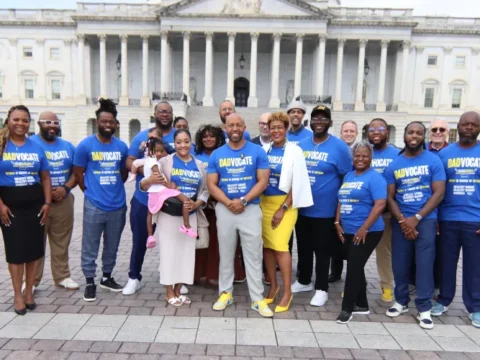
Our new curriculum, Dad & Company: Strengthening the Parenting Team, exists because families thrive on teamwork, communication, and emotional regulation. They thrive on the discipline of co-parenting, whether parents are married, dating, separated, or learning how to work together from two different addresses.
Dad & Company uses FI’s 16-hour father-centered curriculum focused on marriage, co-parenting, and financial stability. Paired with wrap-around case management, it’s designed to serve fathers and co-parents across metro Atlanta and the Columbus, Georgia, area through a five-year federal grant from the U.S. Department of Health and Human Services’ Office of Family Assistance.
The purpose is straightforward: to help families build the skills to sustain healthy relationships and stable parenting environments, because children experience the consequences of our relationship health whether we admit it or not.
In this curriculum, marriage is not a demand, but a destination that requires preparation. We talk about what commitment costs, not just what it looks like. We talk about the difference between romance and reliability. We talk about money, because love without financial clarity often becomes conflict. We talk about conflict, because avoiding hard conversations creates distance, not peace. And we talk about co-parenting as a parenting team, because even when a couple isn’t together romantically, a child still needs the adults in their life to behave like adults.
We also talk about safety.
Any conversation about relationships that ignores safety is not a serious conversation. Love cannot be built on fear. Partnership cannot be built on intimidation. Parenting cannot be built on control. Healthy marriage cannot exist where domestic violence exists. Period.
One of the failures of modern marriage talk is that we celebrate togetherness without teaching people how to keep each other emotionally safe. We encourage reconciliation without discernment. We tell people to “stay” without asking whether staying is dangerous. This isn’t morality. It’s negligence.
Marriage deserves reverence, but not at the expense of people’s well-being.
Celebrating National Marriage Week
So here’s what it looks like to honor National Marriage Week in a way that actually serves families:
- Shift the culture from celebrating weddings to strengthening marriages.
- Change the conversation from “Get married” to “Get ready.”
- Invest in relationship education the way we invest in job training.
- Normalize mentorship, counseling, and community support.
- Refuse to let pride displace repair and silence replace communication.
- Treat marriage as a practice, not a performance.
Celebrating marriage also looks like being honest about the commitment asks of the couple:
- We’re asking two imperfect human beings to choose each other repeatedly and build trust after disappointment.
- We’re asking them to parent through stress.
- We’re asking them to share money, time, space, and responsibility.
- We’re asking them to grow without keeping score.
- We’re asking them to become skilled at apology, forgiveness, and rebuilding.
- We’re asking them to carry family legacy with integrity.
This is sacred work, and one single week will never be enough. A week can highlight marriage, but it cannot hold it. A week can recognize marriage, but it cannot sustain it. A week can celebrate marriage, but it cannot strengthen it. That requires action.
If National Marriage Week is going to mean more than social media posts, it has to be a call to practice, to learn, to repair, and to recommit. It has to be a call to stop treating marriage as an achievement and start treating it as a daily decision.
For some parents, that decision will lead to marriage. For others, it will lead to healthier co-parenting, better communication, greater stability, and safer homes. Either way, our goal must be the same: healthy relationships that can hold the weight of raising children.
At FI, we will always honor marriage as a powerful institution, and we will always honor the journey that makes marriage sustainable. The health and well-being of our children depend on adults who are willing to do the work, not just claim the title.
***
Data sources referenced: U.S. Census Bureau marriage, divorce, and family living arrangement tables and releases, including recent updates on the share of married-couple households, and CDC National Center for Health Statistics marriage and divorce rate trend data (including provisional 2023).