For too long, the public response to vulnerable families has imagined family stabilization without fully imagining the father. We build family services systems exclusively around mothers and babies, and then wonder why fathers remain peripheral.
It’s time to ask about dad, make room for dad, serve dad, and equip dad. It’s time for public policy to reflect the fact that when a father is stabilized, the child is often better stabilized, too.
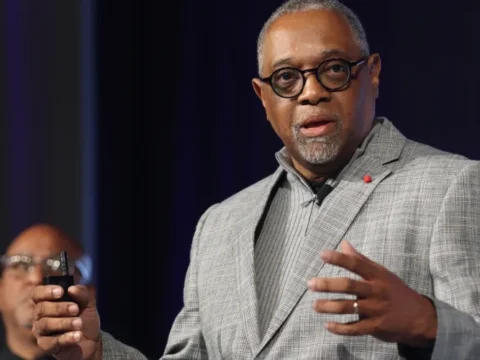
By Kenneth Braswell, CEO, Fathers Incorporated
This report stopped me in my tracks: “Infant and Toddler Homelessness Across 50 States: 2022–2023,” produced by SchoolHouse Connection in partnership with Poverty Solutions at the University of Michigan. The data isn’t merely numbers: It’s a moral mirror.
“Infant and Toddler Homelessness” forces us to look at what it means for nearly half a million of our nation’s youngest children to begin life without the stability of home. According to the report, an estimated 446,996 infants and toddlers experienced homelessness across the United States during the 2022–2023 program year – a number that jumped by 82,000, or 23%, over two years.
Birth to age three is not a casual stretch of childhood. It’s the most intense season of development a child will ever experience. As the report reminds us, a child’s brain develops faster between birth and age three than at any other point in life. And when those years are marked by shelter stays, motel rooms, doubling up with relatives, or nights shaped by instability and uncertainty, the damage isn’t just logistical. It’s developmental, emotional, relational, and physical.
This matters to every person concerned with responsible fatherhood.
Housing instability can turn even a committed dad into a father scrambling at the edges of survival. It can interrupt routines, strain co-parenting, increase conflict, complicate transportation, reduce overnight parenting time, and make it harder for fathers to maintain the calm, predictable, nurturing presence children need. The SchoolHouse Connection report states plainly that homelessness disrupts parents’ ability to be caregivers and to develop nurturing relationships with their children.
This impact should shake up the fatherhood field.
If housing instability disrupts a parent’s ability to nurture, then housing policy is fatherhood policy. If homelessness damages a child’s earliest development, then responsible fatherhood work cannot stop at telling dads to do better. It must also ask whether the systems around families are making it possible for fathers to show up well.
We cannot keep preaching presence while ignoring conditions that undermine it.
Homelessness, Fatherhood, and Child Development
In “Infant and Toddler Homelessness,” SchoolHouse Connections lays out what homelessness means in real life. It’s not only sleeping on a sidewalk or in a shelter. It includes living in motels, staying temporarily with others, or existing in places never meant to hold families together. These are not minor inconveniences. They are traumatic conditions that erode security for children and strain the adults trying to protect them.
These harms begin early. The report notes that homelessness can create a negative developmental environment, one marked by crowded spaces, constant movement, lack of routine, irregular meals, unsafe surroundings, and the presence of unfamiliar people. It links homelessness in early childhood to developmental delays, emotional and behavioral struggles, chronic illness, malnutrition, and long-term health consequences. It even notes that homelessness in infancy is associated with higher asthma rates and more emergency room visits through the first six years of life.
This is a fatherhood issue.
A father reading this report shouldn’t see it as an abstract policy paper. He should see it as a warning and a call. If you are expecting a child, raising a baby, co-parenting a toddler, or trying to stabilize your household, the lesson is unmistakable. Home is not just where children live but part of how children develop. A safe place to sleep, a predictable routine, access to food, a calm environment, and the ability to build rituals of care are all part of fathering. Bath time, bedtime, story time, meals around a table, and the ability to soothe a crying child without worrying about where you will go next are not luxuries. They are the daily architecture of healthy fatherhood.
The report also concerns expectant parents. As we know, fatherhood begins before delivery day, and homelessness during pregnancy brings stress, instability, and health risks into a season that should be shaped by preparation and support. Expectant fathers should hear this clearly. Supporting the mother of your child means more than emotional encouragement. It means taking housing seriously, planning for transportation, locating support programs, understanding where help exists, and reducing instability wherever possible before the baby arrives.
Homelessness, Fatherhood, and Early Childhood Education
Another finding in the report warrants national attention: only 10% of children experiencing housing instability were enrolled in an early childhood development program, such as Home Visiting, Early Head Start, or a Local Educational Agency-funded program. This means that these infants and toddlers are experiencing homelessness without developmental supports to buffer its impact.
Fathers should be thinking hard about that.
A responsible father in this moment must think beyond the four walls of his immediate crisis and ask practical questions. Does my child qualify for Early Head Start? Is there a home visiting program near us? Have I asked about housing assistance? Do I know what local family shelters actually allow fathers to stay? Am I treating my housing challenge as a private burden when it is also a systems issue that deserves advocacy, support, and intervention?
The broader fatherhood policy landscape backs this up. A state-by-state fatherhood policy report released by the Fatherhood Research and Practice Network (FRPN) notes that many low-income noncustodial parents in these studies (most of whom are fathers) report homelessness, living in halfway houses, or paying reduced rent. It also points to the low rate at which eligible noncustodial parents actually receive housing assistance and highlights examples where father inclusion policies pushed shelters to admit fathers rather than treat family homelessness solely as a mothers-and-children issue.
Family Stabilization Efforts Must Include Fathers
This last point deserves to be underlined. For too long, our public response to vulnerable families has often imagined family stabilization without fully imagining the father. We build systems around mothers and babies, and then wonder why fathers remain peripheral.
Responsible fatherhood must therefore expand its frame. Fatherhood work isn’t only about men being emotionally available. It’s also about ensuring that fathers are included structurally. It’s about whether housing and other family services ask about dad, make room for dad, serve dad, and equip dad. It’s about whether public policy understands that when a father is stabilized, the child is often better stabilized, too.
So what should fathers be thinking about as a result of the SchoolHouse Connections report on infant and toddler homelessness? We encourage them to
- Think about preparation. (Not panic, preparation.)
- Think about how fragile stability can be and how early planning matters.
- Think about the power of routine, not just affection or attention.
- Think about co-parenting with urgency and respect.
- Think about help as wisdom, not weakness.
- Think about advocacy, because fathers need to be visible in conversations about family homelessness, maternal health, infant development, early childhood support, and housing access.
- Think about how a child’s earliest sense of safety is built in ordinary moments and consistency. (A crib. A quiet room. A warm bottle. A bedtime uninterrupted by fear. A place where a father can hold his child and not fret about where they’ll sleep tomorrow.)
This is what the report is really about. Babies, yes. Toddlers, yes. But it is also about the conditions required for fathers to flourish and strengthen their families.
If we want responsible fatherhood, then we must want stable families. If we want stable families, then we must confront homelessness with the seriousness it deserves.
And if we claim to care about children in their most formative years, then we cannot keep treating housing as separate from family well-being.