Marriage and fatherhood can’t be treated as competing conversations. Marriage asks how men and women build a stable union. Responsible fatherhood asks how men remain accountable, nurturing, protective, emotionally present, and economically responsible toward their children.
When these commitments exist inside a healthy marriage, they reinforce one another. A man isn’t simply living with the mother of his children. He has made a public covenant to share the labor, sacrifice, responsibility, and future of family life.
By Kenneth Braswell, CEO, Fathers Incorporated
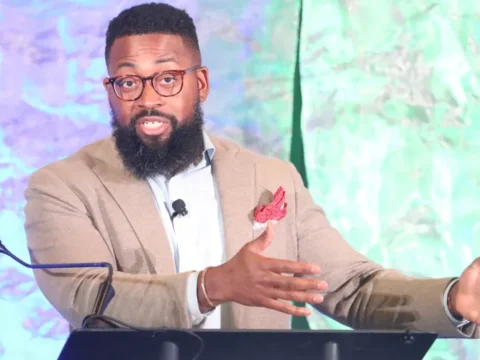
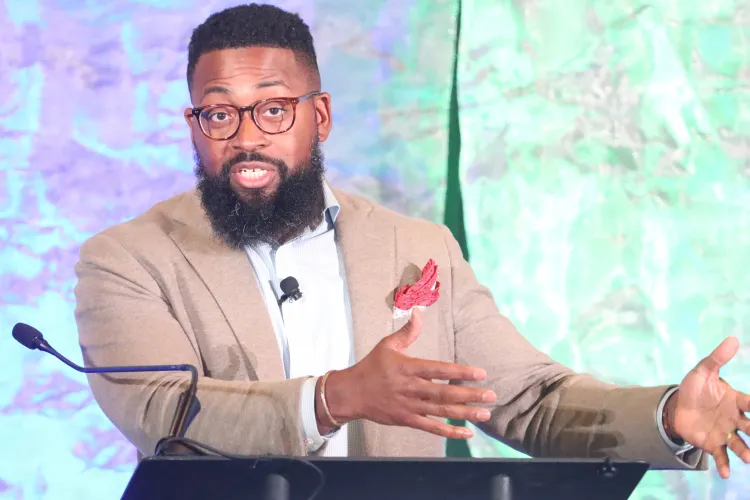
There are moments during a conference when a speaker says something that follows you out of the room and asks you to sit with it longer than you expected. Delano Squires of the Heritage Foundation offered several of those moments at the annual National Alliance on Relationship and Marriage (NARME) in Denver during his keynote address on saving America by saving the family. In his observations, he attempts to capture the distance between the family culture many of us inherited and the one our children are now navigating.
In his remarks, Squires reminded us of the childhood rhyme about a boy and girl sitting in a tree. First came love. Then came marriage. Then came the baby carriage. Today, he said, the sequence sounds different. A young man and woman are staring at their screens, “T-E-X-T-I-N-G.” Then, in his words, “First comes sex, then comes baby, then comes marriage, but that’s a big maybe.” The audience laughed, but it was the kind of laughter that carries discomfort inside it.
Squires wasn’t merely offering a clever critique of dating culture. He was naming a profound transformation in how our country understands commitment, adulthood, marriage, parenthood, and obligation. The order in which people build families has changed. The institutions surrounding families have changed. The expectations placed on men and women have changed. Somewhere within those changes, marriage became less certain, fathers became more negotiable, and children were left to absorb the consequences.
Squires approaches this conversation as a policy thinker, but he isn’t speaking about marriage as an abstraction. In 2010, he began writing publicly for Black and Married with Kids, a platform created to promote positive images of Black families. He later met his wife at a documentary screening organized by the site’s founders. Fourteen years of marriage have given him more than a theoretical stake in the institution he’s defending. Marriage, for him, is personal, cultural, spiritual, and in some ways, political.
“The family is the foundation of civilization,” he told the audience, “and marriage…is its cornerstone.” He described the home as “the training camp of self-government,” the place where mothers, fathers, and children learn cooperation, responsibility, stewardship, sacrifice, and self-reliance.
That phrase, “the training camp of self-government,” deserves more attention than it will probably receive.
Long before a child enters a voting booth, holds a job, pays taxes, serves on a jury, joins a congregation, or participates in civic life, that child is learning how human beings live together. The first lessons in authority, trust, negotiation, forgiveness, accountability, patience, and responsibility are usually learned at home. When those lessons are taught within a loving, stable, and secure family, children aren’t simply being raised. Citizens are being formed.
The data Squires presented in his keynote were sobering:
- In 1970, married couples represented approximately 70% of American households. Today, he said, that figure is about 47%.
- Projections suggest that one-third of young Americans may never marry.
- From 1960 to 2023, the total fertility rate has fallen from 3.65 children per woman to 1.62.
- Approximately 40% of children are born to unmarried parents, and about one-quarter live with a single parent.
- Among adults between 18 and 44, the share who have cohabited exceeds the share who have married.
These aren’t merely statistics about changing household arrangements. They describe a reordering of American life.
Squires’s new book, The Vanishing Black Family: How Welfare and Feminism Made Marriage Optional and Children Vulnerable, places the Black family at the center of that reordering. The book examines 400 years of Black family history, moving through chattel slavery, the expansion of the welfare state, second-wave feminism, the Black leadership class, the Black church, and the institutions that shape public culture. Its second half turns toward solutions through what he calls the church house, the state house, the schoolhouse, and the art house.
His argument is intentionally provocative. He contends that welfare policy and second-wave feminism worked in different ways to weaken the bonds among men, women, marriage, and children. He argues that public policy increasingly displaced men as providers while cultural movements taught women to view marriage, motherhood, domestic responsibility, and dependence on men with suspicion.
Not everyone will agree with every part of that analysis. Serious people can debate the causes, timelines, language, and ideological conclusions. Yet responsible fatherhood practitioners cannot dismiss his central question: What happens when public policy financially penalizes marriage, social institutions presume fathers are absent, and popular culture treats men as optional to family life?
We have seen the answer in the lives of the fathers we serve.
The responsible fatherhood movement emerged, in part, because public systems had learned how to locate fathers for purposes of paternity and child support but had not learned how to engage them as parents. Men were frequently treated as financial obligations before they were treated as emotional resources. They were told what they owed without being shown how to remain connected, communicate with the mother of their children, secure stable employment, understand child development, establish parenting time, or navigate the legal system.
The field responded with a principle of mutual responsibility. Fathers should be required, encouraged, and enabled to contribute to the social, emotional, and economic well-being of their children, whether they live with those children or not. The work eventually centered around employment, relationship skills, parenting education, child support navigation, and services designed to strengthen the entire family.
That history is where Squires’s marriage work intersects most directly with responsible fatherhood.
Healthy Marriage and Responsible Fatherhood
Marriage and fatherhood can’t be treated as competing conversations. Marriage asks how men and women build a stable union. Responsible fatherhood asks how men remain accountable, nurturing, protective, emotionally present, and economically responsible toward their children. When these commitments exist inside a healthy marriage, they reinforce one another. A man isn’t simply living with the mother of his children. He has made a public covenant to share the labor, sacrifice, responsibility, and future of family life.
Yet marriage promotion must never become an excuse to abandon families that do not fit the ideal:
- 40% of children can’t be treated as footnotes because their parents were unmarried when they were born.
- Children already living in single-parent, cohabiting, blended, or shared-parenting families still need their fathers.
- Unmarried fathers remain responsible for their children.
- Mothers raising children outside marriage deserve cooperation rather than condemnation.
- Couples who are no longer romantically connected still have a duty to develop a mature parenting alliance whenever safety permits.
Our research with Black fathers in Fulton County found that the relationship between a father and the mother of his child is among the strongest influences on his involvement. Hostile and competitive co-parenting relationships can reduce father engagement. Supportive parenting alliances can increase paternal confidence, participation, and stability. Fathers in the study also described legal barriers, economic pressures, family conflict, negative stereotypes, and a lack of father-friendly services.
That reality complicates slogans about family decline.
Some men leave. Some refuse responsibility. Some cause harm. Some fathers need to be held accountable before they can be safely engaged. Other fathers are trying to remain present while navigating unemployment, child support debt, housing instability, incarceration histories, strained co-parenting relationships, and legal systems they don’t understand.
Marriage culture won’t be rebuilt by pretending all family breakdown has one cause or that every unmarried father lacks commitment.
The responsible fatherhood field brings something essential to Squires’s marriage revival argument: proximity.
Policy thinkers see marriage penalties in tax and benefit formulas. Cultural commentators see men avoiding commitment. Researchers see declining marriage rates.
But practitioners see the couple at the kitchen table calculating whether marriage will cost them childcare assistance, housing support, food benefits, or health coverage. Fatherhood programs see the young father who loves his child’s mother but is ashamed because his earnings are unstable. We see men who have never witnessed a peaceful marriage and don’t know how to become husbands because no one has ever shown them what husbandhood requires.
A culture can’t demand marriage while refusing to prepare people for it, and Squires understands this.
Squires’ Proposed Solutions for American Families
Squires calls for eliminating marriage penalties in welfare and tax programs, making benefit structures more transparent, improving housing affordability, reforming zoning policies, supporting flexible employment, reducing credential inflation and student debt, and making it economically possible for young adults to form families earlier.
He also proposes a one-time $17,000 Family and Marriage tax credit for married parents with children, with an additional benefit for larger families. He recommends equalizing childcare support so that parents who care for children at home receive consideration comparable to that given to families purchasing commercial childcare. His Newlywed Early Starters Trust, or NEST account, would begin with a modest investment at birth, grow through compound interest, and become available when two young adults marry before age 30, potentially helping with the down payment on a home.
Whether every proposal becomes law is less important than the principles behind them. We can’t say marriage is socially beneficial while constructing public systems that make it financially irrational for low-income couples.
Squires also argues that cultural renewal can’t be delegated to government. As outlined in his book, he insists:
- The church house must teach and model covenant.
- The schoolhouse must give young people honest information about family formation.
- The art house must offer images of men and women loving, sacrificing, parenting, forgiving, and staying.
- The state house must examine whether its policies make stable family life more possible or more difficult.
He highlighted research on the “Success Sequence,” which finds that 97% of the Millennials studied who completed school, obtained employment, married, and then had children were not poor by their mid-30s. He believes children should learn these patterns at age-appropriate levels long before they make permanent decisions about sex, relationships, marriage, and parenthood.
Education, however, must be paired with preparation. Telling young people to marry without teaching communication, conflict resolution, emotional regulation, money management, fidelity, shared decision-making, and parenting is like telling them to build a house while withholding the tools.
Squires’s most practical proposal may be his marriage boot camp for cohabiting couples who share a biological child. He envisions churches using marriage education funding to offer instruction in communication, finances, blended families, fidelity, and conflict resolution. Couples would be paired with marriage mentors. Successful completion would prepare them for marriage, followed by a communal wedding and possibly a financial gift or forgivable loan that rewards couples for remaining married.
This’s where marriage advocacy and responsible fatherhood practice can meet on common ground.
At Fathers Incorporated, our experience has taught us that curriculum alone is not enough. Fathers may need case management, life coaching, legal navigation, employment assistance, mental health support, peer relationships, co-parenting education, and repeated opportunities to practice what they are learning. Our Gentle Warriors Academy (GWA) has combined fatherhood and relationship education with communication training, conflict resolution, financial empowerment, emotional intelligence, child development, case management, and sustained brotherhood.
An independent evaluation found statistically significant improvement in GWA participants’ well-being as parents. It also found that changes in parenting and co-parenting behavior may require longer engagement and continued support. That finding strengthens Squires’s argument for mentors and long-term community. Weddings can be planned in months. Marriages must be supported for years.
Squires concluded by saying there may be “no greater example of privilege in America today” than a child growing up in a loving, safe, secure, stable, low-conflict household with a married mother and father.
The strongest word in that sentence may not be “married.” It may be “safe.”
Marriage alone does not guarantee safety. A marriage certificate can’t substitute for character. Two adults can share a home while exposing their children to fear, hostility, coercion, violence, emotional abandonment, or relentless conflict. The responsible fatherhood field must therefore insist that marriage promotion be safety-led, child-anchored, and accountability-shared. We should encourage healthy marriages, not merely intact appearances. We should support fathers who lead with love, humility, restraint, protection, and emotional presence.
Still, we shouldn’t be afraid to say that marriage matters because:
- Children benefit from stability.
- Commitment provides a framework for shared responsibility.
- Fathers are more likely to remain connected when their relationship with the child’s mother is healthy and supported.
- Marriage can gather emotional, social, spiritual, and economic resources for a child.
- Family life should be more than a private arrangement that lasts only as long as every adult feels personally fulfilled.
Squires ended with an agricultural image. The word culture is connected to the preparation and cultivation of land. We must plant, water, weed, and prune what we want to grow. This may be the most enduring lesson of his address.
We can’t lament the disappearance of marriage while neglecting the soil in which marriage must grow. We can’t ask men to become husbands without helping boys develop discipline, purpose, emotional maturity, and respect for women. We can’t ask women to trust men who’ve never been prepared to carry the weight of trust. We can’t tell couples to remain together while ignoring housing costs, unstable employment, childcare expenses, untreated trauma, and policies that punish their union.
We can’t call fathers indispensable in speeches and optional in family-serving systems.
Marriage revival will require more than nostalgia. Responsible fatherhood will require more than demanding financial support from dads. Both movements must meet where real families live, where love is often present but skills are missing, where commitment is desired, but fear is strong, and where children are waiting for adults and institutions to place their needs above ideology.
The work isn’t to recreate an imaginary past. The work is to cultivate a future in which marriage is again viewed as valuable, fatherhood is never treated as optional, mothers are supported rather than left alone, and every child has the opportunity to grow within relationships shaped by safety, stability, sacrifice, responsibility, and love.
That future will not arrive because we wished for it.
We will have to plant it.