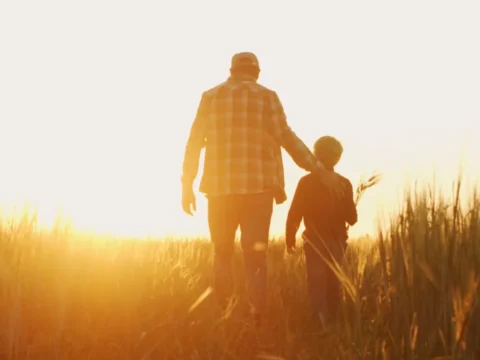

It is about the father who is living in the home and the father who is fighting to stay connected from outside the home. It is about the father who has custody and the father who is trying to understand his rights. It is about the father who is married, unmarried, divorced, separated, widowed, young, aging, healing, returning home, starting over, or finally finding his voice. It is about the father who is celebrated and the father who has never heard anyone say, “We see you.”
By Kenneth Braswell
CEO, Fathers Incorporated
There comes a time when a movement has to stop waiting for permission to name what it already knows to be true.
For too long, those of us who care about fathers, children, families, and communities have looked outward for validation. We have waited for another institution, another office, another proclamation, another calendar, another committee, another cultural moment to tell us when fatherhood deserves attention. We have accepted scattered references, softened language, occasional applause, and one Sunday in June as though that was enough.
It is not enough.
One day is not enough to carry the weight of what fathers mean to children. One weekend is not enough to honor the quiet sacrifices, the late-night worry, the legal battles, the school drop-offs, the child support payments, the second jobs, the therapy sessions, the co-parenting conversations, the spiritual rebuilding, the healing from one’s own father wounds, and the daily decision so many men make to stay, to return, to repair, to provide, to protect, to nurture, and to love.
That is why Fathers Incorporated is declaring June National Fatherhood Month.
We are not asking for permission. We are not waiting for consensus. We are not soft-launching the idea. We are declaring it with clarity, conviction, and purpose.
June belongs to fatherhood.
This does not diminish anyone else. It does not compete with any other observance. It does not deny the beauty, pain, complexity, or diversity of family life. It simply says that fatherhood deserves a month of focused attention, celebration, advocacy, organizing, storytelling, and action. It says fathers should not have to enter every family conversation through the side door. It says the language of family must make room for fathers by name.
We have seen what happens when society treats fathers as optional. Systems learn to ignore them. Schools learn to call mothers first. Courts learn to see fathers primarily through enforcement. Human service agencies learn to build programs that assume men are absent before they ever ask whether they have been invited. Media narratives learn to flatten fathers into stereotypes. Children learn, sometimes without anyone saying it aloud, that celebrating fathers is less urgent, less emotional, less necessary.
That lesson is unacceptable.
A child should never grow up in a culture where fathers are treated as secondary to the architecture of family life. A boy should not have to wonder whether becoming a father will make him visible only when he fails. A girl should not have to search the margins of public life to see fatherhood honored with the tenderness and seriousness it deserves. A father should not have to prove that his love is real simply because systems were not designed to recognize it.
At Fathers Incorporated, we have spent more than two decades listening to fathers. We have listened in courtrooms, barbershops, classrooms, jails, community centers, churches, podcasts, conferences, and living rooms. We have heard the same truth again and again. Fathers want to be seen. Fathers want to be equipped. Fathers want to be respected. Fathers want to be invited into the lives of their children, not only when there is a bill to pay, a problem to solve, or a mistake to explain.
We have also learned that fathers do not need pity. They need pathways. They need policy. They need community. They need legal access. They need mental health support. They need workforce opportunities. They need co-parenting tools. They need places where they can speak honestly without being mocked, reduced, or dismissed. They need a field that is strong enough to advocate for them and honest enough to hold them accountable.
National Fatherhood Month gives us a frame for that work.
During June, we should celebrate fathers publicly and personally. We should tell stories that show fathers holding babies, reading books, attending IEP meetings, coaching teams, showing up in court, rebuilding trust, making memories, caring for mothers, protecting children, and becoming healthier men. We should fill our platforms with images that do more than sell neckties and grilling tools. We should tell the truth about fathers as caregivers, nurturers, teachers, providers, advocates, and healers.
During June, we should advocate for fathers with policy seriousness. We should ask whether child support systems help fathers stay connected or push low-income fathers deeper into debt. We should ask whether family courts create pathways to parenting time or make legal access too expensive and confusing. We should ask whether maternal and child health systems engage fathers during pregnancy, birth, and postpartum recovery. We should ask whether schools collect father contact information and use it. We should ask whether child welfare systems identify, locate, assess, and engage fathers as part of the family solution.
During June, we should convene the fatherhood field with urgency. We need conferences, think tanks, policy roundtables, community forums, listening sessions, father-led gatherings, research briefings, and public conversations that sharpen our collective agenda. We need to bring together practitioners, researchers, policymakers, funders, faith leaders, business leaders, educators, mothers, co-parents, and fathers themselves. A field becomes stronger when it gathers, names its priorities, debates its direction, and moves with shared purpose.
During June, we should make room for fathers to speak for themselves. Too many conversations about fathers happen without fathers in the room. That must change. Fathers are not case studies. Fathers are not talking points. Fathers are not merely data categories. Fathers are human beings with stories, wounds, wisdom, responsibilities, and dreams for their children.
We are calling this National Fatherhood Month because the word itself is enough.
We do not need to place an adjective in front of fatherhood to make it respectable. We do not need to qualify it with language that changes according to someone else’s comfort level. Words like “good,” “responsible,” “involved,” and “active” all have meaning in certain contexts, but they also carry judgments that can be defined differently depending on who is speaking, who is listening, and who has power. This month is not about narrowing fatherhood to a single approved image. It is about lifting the full conversation.
We also do not need to dilute the focus by adding every possible substitute for the word father. There are uncles, grandfathers, mentors, coaches, pastors, brothers, and community men who have loved children powerfully and faithfully. They deserve honor. Many of them are fathers in every meaningful sense of the word. But Father’s Day is Father’s Day. National Fatherhood Month is National Fatherhood Month. If a man knows himself to be a father, if a child knows him as father, if he carries the responsibility, presence, love, and commitment of fatherhood, then the word does not need to be softened for public consumption.
This month is about fathers.
It is about the father who is living in the home and the father who is fighting to stay connected from outside the home. It is about the father who has custody and the father who is trying to understand his rights. It is about the father who is married, unmarried, divorced, separated, widowed, young, aging, healing, returning home, starting over, or finally finding his voice. It is about the father who is celebrated and the father who has never heard anyone say, “We see you.”
In 2026, Fathers Incorporated is planting a flag.
This year, the declaration begins. Over time, the work will grow. We will build programming around it. We will invite partners into it. We will develop campaigns, events, research, policy conversations, and community activations. We will ask cities, states, organizations, schools, congregations, and families to join us. But movements do not begin fully formed. They begin when someone is willing to speak the thing out loud.
So we speak it now.
June is National Fatherhood Month.
Let fathers be celebrated. Let fathers be advocated for. Let fathers be invited. Let fathers be studied with dignity. Let fathers be supported with resources. Let fathers be challenged with love. Let fathers be held in the public imagination as essential to the lives of children and the future of families.
Let children see us honor their fathers.
Let systems learn to ask, “What about dad?”
Let communities say without hesitation that fathers matter.
And let this be the year we stop waiting for someone else to declare what we already know.
Proclamation Declaring June as National Fatherhood Month
Whereas, Fathers Incorporated believes that fathers are essential to the emotional, social, educational, spiritual, and economic well-being of children, families, and communities, and that fatherhood deserves focused national recognition, celebration, advocacy, and investment; and
Whereas, June is widely recognized as the month in which the nation celebrates Father’s Day, offering families, communities, institutions, and systems an opportunity to honor the presence, love, labor, sacrifice, guidance, and commitment of fathers; and
Whereas, Fathers Incorporated affirms that Father’s Day is Father’s Day, and that the month surrounding it should be lifted with clarity as a time to focus specifically on fathers and fatherhood; and
Whereas, fathers contribute to their children’s development through love, caregiving, protection, provision, emotional support, guidance, discipline, cultural identity, educational involvement, and the daily work of being present in the lives of their children; and
Whereas, every child has a father, and the central question for families, systems, and communities is whether that father is known, engaged, supported, encouraged, and empowered to be present in healthy, constructive, and meaningful ways; and
Whereas, too many fathers experience barriers that limit their ability to remain fully engaged with their children, including legal obstacles, child support challenges, unemployment, underemployment, incarceration, housing instability, mental health stigma, co-parenting conflict, family court complexity, and systems that too often fail to identify, invite, or include them; and
Whereas, the fatherhood field has grown through decades of advocacy, research, direct service, training, policy development, community organizing, and the leadership of fathers and father-serving organizations across the country; and
Whereas, Fathers Incorporated recognizes the need to strengthen and unify the fatherhood field through national conversations, public campaigns, conferences, think tanks, research forums, community events, training institutes, policy roundtables, and father-led gatherings; and
Whereas, the celebration of fatherhood must be more than symbolic, and should include concrete efforts to improve systems, expand resources, increase father-inclusive practice, elevate positive narratives, support father-child relationships, and ensure that fathers are visible in every space where family well-being is discussed; and
Whereas, National Fatherhood Month is intended to celebrate fathers without qualification, condition, or dilution, recognizing the dignity of fatherhood without requiring additional adjectives before the word fatherhood or substitute labels that shift attention away from fathers themselves; and
Whereas, Fathers Incorporated honors fathers in the fullness of that name, including biological fathers, adoptive fathers, stepfathers, legal fathers, kinship fathers, married fathers, unmarried fathers, residential fathers, nonresidential fathers, young fathers, older fathers, returning fathers, healing fathers, and all men who carry and live the identity, responsibility, and love of being a father; and
Whereas, children deserve to see fathers celebrated, communities deserve to see fathers supported, and the nation deserves a stronger, clearer, more courageous conversation about the value and essentialness of fatherhood; and
Whereas, Fathers Incorporated has committed itself since 2004 to engaging, equipping, and empowering fathers and families, and now calls on partners, practitioners, policymakers, schools, faith communities, businesses, civic organizations, and families to join in a national observance that uplifts fathers with dignity and purpose;
Now, therefore, Fathers Incorporated does hereby declare June 2026, and every June thereafter, as National Fatherhood Month.
We call upon communities across the nation to celebrate fathers, advocate for fathers, listen to fathers, invest in fathers, convene conversations about fatherhood, promote father-inclusive policies and practices, and honor the irreplaceable role fathers play in the lives of their children and families.
Let this declaration stand as a call to action, a public affirmation, and a movement-building commitment.
Declared this day by Fathers Incorporated in the year 2026.
Kenneth Braswell
Chief Executive Officer
Fathers Incorporated