
For more than three decades, I’ve watched fathers enter child support offices, courtrooms, legal clinics, mediation sessions, DFCS meetings, and community programs carrying a combination of fear, frustration, determination, paperwork, and uncertainty.
Many of them know exactly what they want in the broadest sense. They want to remain connected to their children, understand what’s expected of them, and fulfill their responsibilities, and they want a fair opportunity to participate in decisions affecting their children.
What they often don’t know is how the system in front of them actually works.
By Kenneth Braswell, CEO, Fathers Incorporated
Why Fathers Incorporated created the Georgia Family Court Navigation Guide, and why system literacy may be one of the most practical forms of fatherhood support we can offer
For more than three decades, I’ve watched fathers enter child support offices, courtrooms, legal clinics, mediation sessions, DFCS meetings, and community programs carrying a combination of fear, frustration, determination, paperwork, and uncertainty.
Many of them know exactly what they want in the broadest sense. They want to remain connected to their children, understand what’s expected of them, and fulfill their responsibilities, and they want a fair opportunity to participate in decisions affecting their children.
What they often don’t know is how the system in front of them actually works.
One of the first things they learn is that language alone can be a barrier. Custody. Parenting time. Paternity. Legitimation. Contempt. Modification. Arrears. Dependency. Guardianship. Protective order. Abandonment. Service. Jurisdiction. Venue. Relief requested.
These terms may be familiar to lawyers, judges, caseworkers, and people who operate within family systems every day. But to a father seeing them for the first time on a document that could affect when he sees his child, where his child lives, how much money he owes, or whether he even has legal standing to ask the court for parenting time, they can feel like another language.
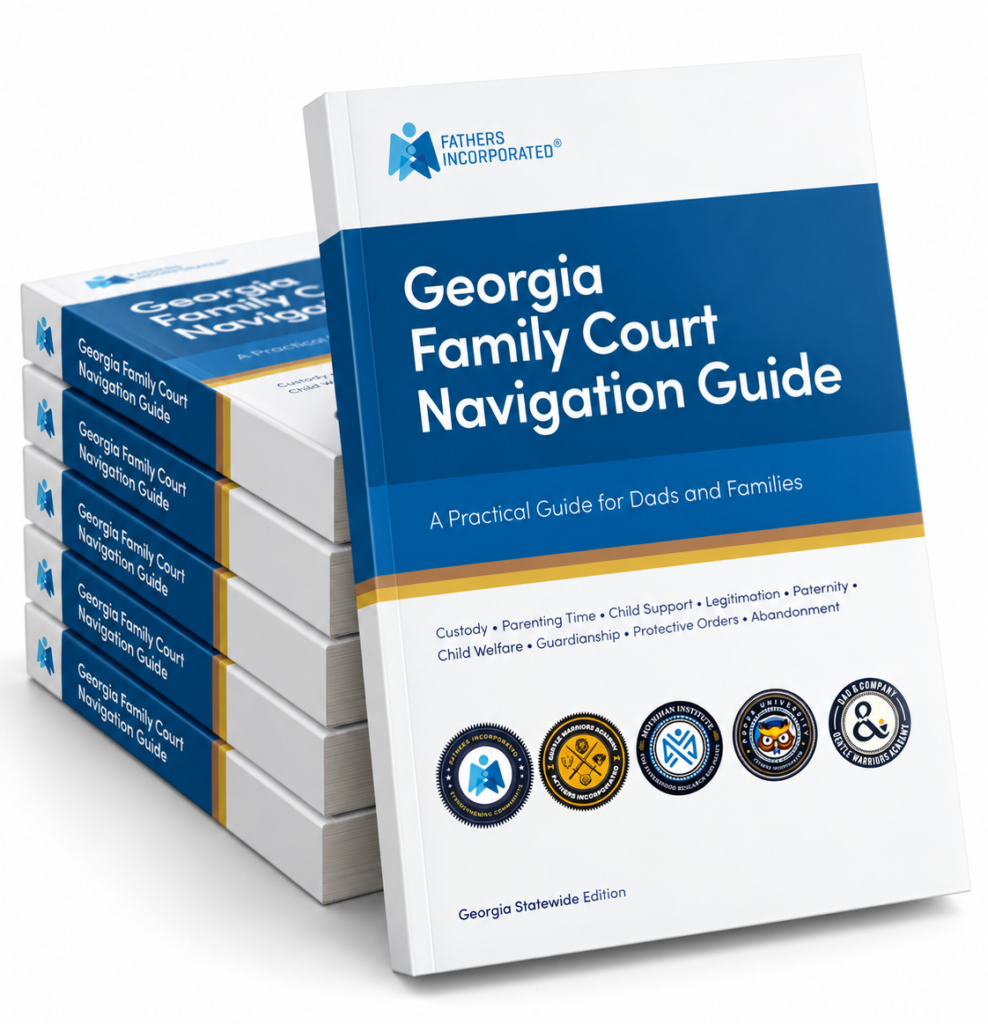
That’s why our Georgia Family Court Navigation Guide begins somewhere different. It begins with a question for fathers: What are you trying to do? Establish parenting time? Understand child support? Legitimate your child? Respond to a protective order? Figure out why DFCS is involved? Understand who actually has guardianship? Determine which court issued the paper in your hand?
The Georgia Family Court Navigation Guide helps fathers recognize the issue, identify the system that may handle it, understand the language being used, and take a more informed next step.
That approach may sound basic until you spend enough time with fathers to understand how consequential basic information can become.
Georgia Fathers Need Help Navigating Courts
Our work repeatedly shows us that family legal systems aren’t peripheral issues in the lives of the fathers we serve. They’re often central. In our Gentle Warriors Academy (GWA), fathers consistently say they need help with legitimation, child support, parenting time, custody, and other family legal matters.
From 2021 through 2023, nearly 450 GWA participants expressed a need for legitimation services alone. Behind that number are not 450 legal abstractions. They’re fathers asking intensely human questions:
- Can I see my child?
- Can I participate in decisions about school?
- Why am I paying child support but still don’t have a parenting-time order?
- What happens if I lose my job and can’t pay the full amount ordered?
- Does signing the birth certificate make me the legal father?
- What exactly am I supposed to do with these papers?
Our Moynihan Institute for Fatherhood Research and Policy (MIFRP) has heard the same concerns directly from fathers. In its exploratory research with young fathers in Atlanta’s NPU-V, conducted under the direction and management of Fathers Incorporated and funded by the Anne E. Casey Foundation, researchers found a shortage of supportive services specifically designed for fathers.
This fatherhood research documented the difficulties men experienced trying to navigate economic pressure, stigma, co-parenting challenges, and legal systems. One father summarized the need with painful simplicity: Fathers need legal guidance early, before “stuff happens” and they’re trying to understand their rights in the middle of a crisis.
MIFRP-affiliated research with Black fathers in Fulton County found that co-parenting difficulties and lack of community support could operate as barriers to paternal engagement. Nevertheless, these fathers demonstrated resilience and persistence in trying to remain positive presences in their children’s lives. We owe it to these dads to meet this persistence with support and resources.
Fathers Are Seeking Legal Literacy Through AI
The fathers’ own descriptions of the legal system are even more revealing. Some spoke about the anxiety of court appearances, unfamiliar terminology, lack of representation, child support, and Georgia’s legitimation process. One participant described feeling as though he nearly had to become a lawyer just to figure out how to see his children.
That isn’t merely a complaint about the court. It’s a systems-literacy problem.
The answer isn’t to turn every father into an attorney. Fathers Incorporated isn’t a law firm, and our guide makes that boundary explicit. We provide education, information, navigation, and support. We don’t tell a father what legal decision to make, predict what a judge will do, or replace qualified legal counsel.
What we can do is help a father become a more informed participant in his own life.
That distinction has become even more urgent because of artificial intelligence. In our recent piece, “AI Can Write a Legal Motion, But Can’t Guarantee a Father Gets to See His Child,” I wrote about research examining roughly 2.8 million federal civil filings and nearly 13,000 complaints by self-represented litigants. The research found that after generative AI became widely available, self-represented filings increased significantly. AI-assisted complaints often looked more polished and included more citations, yet they didn’t perform better.
They were also dismissed more frequently, ended earlier, and were no more likely to prevail. The researcher described what amounts to a litigation-efficacy paradox: greater access to legal form without greater access to remedy.
That research wasn’t specifically about fathers or family court, and we shouldn’t pretend otherwise. But the lesson should matter deeply to anyone working with self-represented parents: Generating legal language via AI isn’t the same as understanding a legal system.
A father can now take a child support order, upload the language into an AI tool, and ask for an explanation. He can create a timeline. He can organize questions. He may even be able to produce something that resembles a professionally written legal motion. These capabilities have real value.
I believe AI can become a powerful translator and navigator, but there’s real danger when navigation turns into imitation of representation. A father can walk into court carrying a beautifully drafted motion filled with case citations and legal terminology. Then a judge can ask three simple questions: What evidence supports this? What are you asking me to order? Why does that law apply to your situation? If the father can’t answer these questions, the document’s polish hasn’t solved the underlying problem.
Our AI op-ed called out this distinction plainly: Access to information isn’t access to representation. Access to document creation isn’t access to legal understanding. Access to a motion isn’t access to a child.
That same philosophy shaped our Georgia Family Court Navigation Guide.
How the Georgia Family Court Navigation Guide Helps Fathers

Our Court Guide doesn’t try to make fathers sound like lawyers; it tries to help fathers understand what’s happening around them.
Key sections explain that paternity isn’t the same as legitimation, child support isn’t the same as custody, and different courts do different things. There are sections about legitimation, child support, DFCS, guardianship, abandonment, protective orders, court preparation, documentation, and what to do when legal papers arrive.
One of my favorite pages simply says: “Your memory isn’t your case file.” It encourages systems literacy, including
- Finding the order
- Identifying which court
- Noting the case number
- Knowing the hearing date
- Keeping the payment record
- Preserving important communications
- Understanding what you’re asking the court to do
There’s also a larger lesson beneath all of this, and it’s one we teach constantly through Fathers Incorporated: A father must learn how to function inside systems that don’t experience his circumstances emotionally.
I don’t mean that fathers should become emotionless. A custody dispute is emotional. Being separated from your child is emotional. Being accused of something is emotional. Struggling to make a child support payment is emotional. Feeling ignored by a system is emotional. The emotions are real and deserve a healthy place to be processed.
The courtroom, however, is still going to ask for facts. The agency is still going to ask for documentation. The order is still going to say what the order says. The deadline remains the deadline.
That’s why resilience, steadiness, and mindfulness aren’t soft concepts in our work. They’re practical navigation tools:
- Resilience means understanding that a difficult ruling, missed opportunity, setback, or painful moment doesn’t have to become the permanent definition of your fatherhood.
- Steadiness means refusing to allow every provocation to determine your next move.
- Mindfulness means remaining conscious of where you are, what the system is asking, what your long-term goal is, and whether the next action you’re considering moves you closer to your child or farther away.
Sometimes the most important legal decision a father makes isn’t sending the text. The guide addresses that, too.
We encourage fathers to document facts rather than fights, preserve relevant communication, avoid threats and insults, keep children out of adult disputes, and communicate as though someone else may eventually read what they write.
It isn’t about performing for a judge. It’s about maturity.
Our Georgia Family Court Navigation Guide Is for Practitioners, Too
We built the Court Guide for Georgia dads, especially fathers who may not have ready access to an attorney or who’ve never been taught how these systems operate. We built it for unmarried fathers who don’t yet understand the difference between biological fatherhood and legal fatherhood. We built it for fathers navigating child support, parenting time, DFCS involvement, guardianship, protective orders, or court papers they can’t decipher.
But we also built it for fatherhood practitioners and others who serve fathers and families:
- A caseworker should be able to hand this to a father.
- A child support professional should be able to point Dad toward the section explaining that financial support and parenting time are separate systems.
- A legal aid organization should be able to use it to help a father arrive at an appointment with better questions.
- A judge, mediator, probation officer, school social worker, faith leader, reentry provider, community organization, or family-serving agency should be able to say, “Start here.”
The system itself benefits when the people entering it understand what’s being asked of them.
Better information doesn’t guarantee better outcomes. It can, however, improve preparation, reduce avoidable mistakes, clarify expectations, and help fathers recognize when they’ve moved beyond education and navigation into a situation requiring legal representation.
That last point matters enormously in the age of AI. Fathers must not confuse AI capabilities with professional legal representation. Responsible fatherhood practitioners must build stronger bridges connecting fathers to understandable information, credible resources, qualified attorneys, courts, child support agencies, child welfare systems, and people who can help them determine what comes next.
Before a father puts his name on a document, he should be able to explain what it says, what facts it asserts, what he’s asking for, and what may happen next. The Georgia Family Court Navigation Guide is one step toward building that bridge.
Additional Resources for Family Court Navigation
The Guide represents the beginning of a growing family-court navigation center. We’re developing accompanying “Mini-Mods” and other short videos that will take issues from the guide and bring them to life: paternity versus legitimation, child support and parenting time, documentation, protective orders, abandonment, preparing for court, receiving legal papers, and navigating child welfare involvement.
Because sometimes a father needs to read it. Sometimes he needs to hear someone explain it. Sometimes he needs to see an example. Sometimes he needs to ask for help. All four should be available.
For more than 30 years, Fathers Incorporated has never assumed that systems alone determine whether fathers succeed. Fathers have responsibilities, too. They must show up, support their children, regulate their behavior, accept accountability, and make different choices when old choices are harming their families.
That responsibility doesn’t operate in a vacuum, however. Fathers encounter economic pressures, community-resource gaps, co-parenting challenges, legal barriers, institutional experiences, and systems that can either help them understand the path or make that path harder to see.
The research from Fulton County is especially instructive because the fathers described both barriers and persistence. They didn’t simply describe what stood in their way. They continued expressing a desire to remain engaged with their children.
The combination matters:
- Responsibility and systems literacy
- Accountability and access
- Persistence and preparation
- Technology and human judgment
- Rights and responsibilities
Fatherhood has always required us to hold more than one truth at a time.
The court system can determine an order. It can determine a payment. It can determine legal status. It can establish restrictions. It can set a schedule. It can make decisions with enormous consequences for a family.
What the system shouldn’t determine is whether a father gives up on becoming knowledgeable, responsible, steady, and appropriately involved in his child’s life.
A father shouldn’t have to learn the system by making mistakes inside it.
He should have the opportunity to learn before the next mistake becomes a missed deadline, an unpaid obligation, an angry message, an unnecessary filing, a misunderstood order, or another month away from his child.
That’s why we built the guide: Know the issue. Find the right system. Take the next step. And never confuse being caught inside a system with surrendering authorship of the father you still have the opportunity to become.
Kenneth Braswell is CEO of Fathers Incorporated and founder of Gentle Warriors Academy. The Georgia Family Court Navigation Guide is a free statewide educational resource for dads and families and will be available through POPPA University at www.poppauniversity.com.